By Kate Nelson, Strong Cities Network / Former City of Boise Deputy Chief of Staff
In the modern landscape of municipal governance, city leaders face a daunting paradox. We are expected to be the first line of defense when our communities fracture—whether from hate crimes, mass violence, or polarizing unrest. Yet, as outlined in recent case studies, cities often face significant hurdles: we operate without a clear mandate to lead prevention efforts, possess limited resources to develop new policies, and struggle against bureaucratic constraints that impede rapid local action.
Across the Strong Cities Network, we see this struggle repeated. Cities are often left to manage the “invisible cost” of crisis: eroded trust, decreased mental wellbeing, and slowed economic recovery. In Boise, Idaho (a city of approximately 240,000 residents across 80 square miles), where I served in the City Government from 2020 to 2025, we realized that trauma is not just a mental health issue; it is a civic infrastructure issue. To protect that infrastructure, we embarked on a rigorous development process to create the Community Trauma Response (BCTR) Plan. The resulting framework is highly adaptable and commensurate with the demographics and scale of small to mid-sized cities.
This is the story of how we moved from a reactive stance to one of Proactive Resilience, and how your city can adapt this model to fill the gaps in your own safety net.
The Invisible Cost of Crisis
The decision to invest time in a “soft” asset like a trauma response plan was driven by hard data. We define a Community Traumatic Event (CTE) as one that is extremely negative, uncontrollable, and sudden. Emergency responders, including Fire and Police, are expertly trained to handle all phases of a crisis, including natural disasters, technological failures, and mass violence. This plan does not compete with or duplicate those essential emergency management functions. Instead, the BCTR Plan is designed to support our civic leaders— the Mayor and City Council—to keep the peace, act as the unifying force, and strategically oversee the community’s emotional and social recovery long after first responders have concluded their immediate, life-saving duties.
The real-world consequences of this gap are immediate and logistical. In Boise, prior to the development of our plan, a well-intended response to an act of violence at a local hospital inadvertently led to an ambulance bay being blocked when community members created a spontaneous memorial. This act of kindness posed critical safety concerns and created additional labor for hospital staff. Already under strain, medical personnel were forced to divert attention from patient care to move items and manage overwhelmed offers of assistance.
This incident illuminated a critical lesson: without a plan, even “help” can become a hazard.
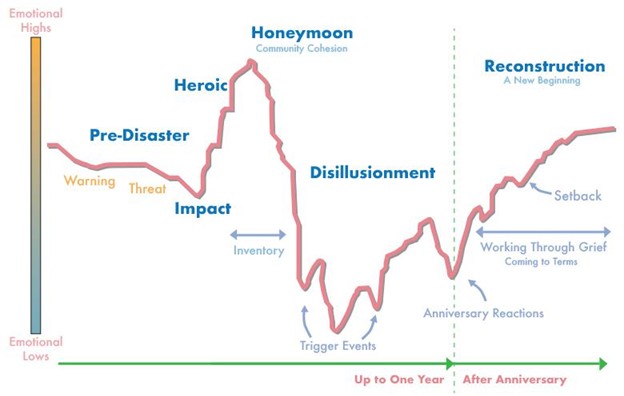
The “Typical Phases of Disaster” curve further illustrates this trajectory. Immediately after an event, there is often a “Honeymoon” phase of community cohesion. But without structure, this inevitably gives way to a deep trough of “Disillusionment”—a period where grief turns to anger, and civic fabric tears.
We realized that if we didn’t have a plan to bridge the gap during the “Disillusionment” phase, we were leaving our community vulnerable to a secondary wave of crisis.
Response and Prevention: A Dual Mandate
We approached the BCTR Plan with a dual mandate. First, we needed an Immediate Response tool—a way to provide rapid, coordinated support that stabilizes the community without causing further harm (re-traumatization). Second, we sought Preventative Stabilization. We found that the mere existence of a plan signals to residents that their city is prepared, reducing anticipatory fear and increasing trust before a crisis even occurs.
The entire planning effort was funded by a one-time allocation from the Mayor’s Office budget and had an ambitious one-year deadline. This strict timeline was challenging, but it kept the Core Team focused and enabled tidy, quarterly deliverables, ensuring momentum never flagged.
To achieve our goals, we engaged in a rigorous “Human-Centered Design” process, focusing on “Filling Gaps” where no clear lead agency existed.
The Engine of Resilience: The Core Team
The success of the BCTR Plan—both in its creation and its future execution—relies heavily on the structure of the Core Team. In our plan, the Core Team is a group of senior leaders from a specific, interdisciplinary body comprised of representatives from Fire, Law Enforcement, Health, Education, and the Mayor’s Office. This composition was critical. By bringing these specific sectors together, we ensured that the plan was not “owned” by a single silo, but rather shared across the vital organs of the city.
The Core Team’s Role in Creation:
During the development phase, the Core Team provided the essential oversight required to navigate bureaucratic hurdles. They defined the specific “activation events” (such as hate crimes or mass violence) that would trigger the plan and established the engagement strategy. Their cross-sector authority allowed us to “complement, not compete” with existing emergency protocols.
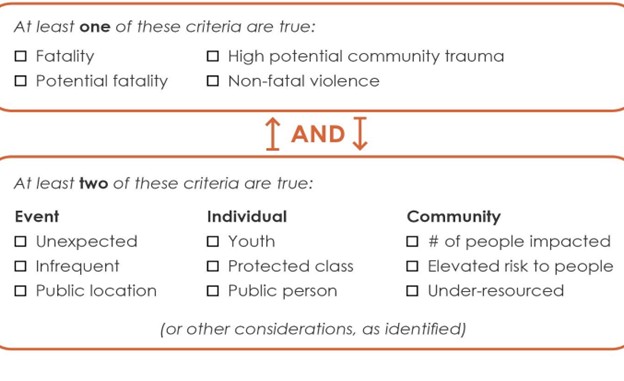
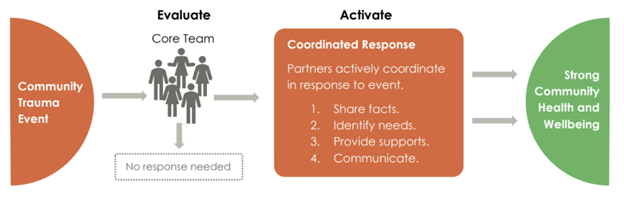
Crucially, we relied on the support of an outside consulting firm. We could not have completed the dozens of listening sessions with hundreds of individuals and incorporated this input without professional support. Just as, if not more, important, we had to have the right consultants—ones that were mission-aligned, adept at working within city government processes, and skilled at graphically representing complex information in comprehensive but easy-to-understand ways. We succeeded in large part because of having the right strategic partners.
The Core Team’s Role in Execution:
In the event of a crisis, the Core Team serves as the stable center of gravity. Their primary function is to avoid the paralysis of decision-making. When a potential crisis hits, the Core Team convenes to utilize a strict Activation Criteria Checklist. This objective tool asks: Is there a fatality? Is the event unexpected? Does it affect a protected class?
If the criteria are met, the Core Team activates the plan and deploys Tiger Teams—cross-functional groups of frontline staff and community partners (such as youth counselors or faith leaders) who act as boots-on-the-ground responders. The Core Team remains in the “command center,” handling communications and resource allocation, allowing the Tiger Teams to focus on community stabilization.
The Framework in Action: A Cycle of Resilience
Emergency plans are essential, but the BCTR model is designed for continuous engagement, utilizing a cycle of three states : Readiness, Activation, and Steadiness. We recently saw this framework tested in real-time following a tragic fire that took the lives of young children and left others in critical condition.
- Readiness: The Power of “Blue Sky” Planning
In the “Green” state, our focus is on connection. Because we had utilized this time to break down silos, the Police Core Team member was able to quickly alert the rest of the Core Team the moment the tragedy occurred. - Activation: Clarity in Chaos
The Core Team convened and determined the evaluation criteria were met, moving the plan from Readiness to Activation. Unlike previous incidents, there was no confusion about roles. A Tiger Team was immediately formed, which included leadership from the neighborhood association and a church close to the site of the fire. Residents were able to support those closest to the loss in an organized fashion, ensuring that the support provided was wanted, helpful, and did not interfere with emergency operations. - Steadiness: Heal the Healer
Eventually, the immediate crisis fades, and we move to the “Grey” state. Here, we focus on the transition to long-term support and the wellbeing of our staff. Crucially, we included a protocol we call “Heal the Healer.” We recognized that city staff and community partners absorb immense trauma during a response. Our plan explicitly includes debriefing and mental health support for the responders themselves, ensuring our internal capacity remains intact for the future.
The Pillars of Success: Essential Prerequisites for Adaptation
For any municipality looking to adopt the BCTR framework, the infrastructure of the plan itself is secondary to the quality of the commitment behind it. The following three elements are absolutely essential for a successful launch and sustained impact:
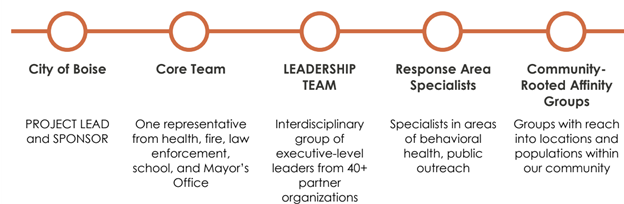
- Sustained Executive Leadership (The ‘Why’): The plan requires complete buy-in and demonstrable trust from the Mayor and/or City Manager. This initiative cannot be treated as a side project delegated to mid-level management; it must be championed by an executive leader who publicly owns the long-term vision. This buy-in signals to all city departments that trauma response is a strategic priority, not an optional activity.
- Empowered Core Team (The ‘How’): Core Team members must not only understand the vision but also possess executive-level authority to make cross-departmental decisions in real-time. This interdisciplinary team—representing critical sectors like Fire, Police, Health, Education, and Administration—must have the license to operate outside of traditional organizational boundaries when the plan is activated.
- Community Commitment (The ‘Reach’): The plan’s reach must extend deep into the community’s fabric. Success requires the committed involvement of key community leaders and institutional partners, including:
- Large Employers and Hospital Systems
- University and School District Leadership
- Non-profit and Faith Community Leaders
- Groups representing special populations (seniors, physically disabled, unhoused, etc.)
Findings: Improving Civic Infrastructure
Qualitative data obtained after we moved from Activation to Steadiness following the fire clearly articulated the value of this approach:
- Community Ownership: Residents expressed a profound sense of ownership, pride, and relief. They were grateful for the opportunity to participate in providing support in a structured, meaningful way.
- Relief for Responders: Emergency responders expressed significant relief and gratitude. They reported that knowing support for the victims would continue after their jobs as first responders concluded allowed them to focus on their duties without the lingering “moral injury” of leaving a grieving family unsupported.
- The Value of Connection: Perhaps the most surprising finding emerged not from the plan’s execution, but its creation. During the development phase, organizations that had long worked adjacent to one another—such as school district officials and neighborhood associations, or faith leaders and emergency managers—connected for the first time. This “blue sky” collaboration provided tremendous value, fostering a pervasive sense of safety and belonging. Participants reported feeling part of something bigger than their individual mandates, creating a resilient web of relationships that adds value to the city every day, not just during a crisis.
Through our outreach and research, we identified several other key benefits that extend beyond simple crisis management. By implementing this framework, cities can achieve:
- Communication: Increased reach and coordination of messaging during an event, reducing the spread of misinformation.
- Resources: Increased awareness of partner resources (from food banks to mental health services) and how to leverage them immediately.
- Network: The breaking down of professional silos, creating a web of relationships that functions even when there is no crisis.
- Pathway: Clear direction for staff and residents on “who to talk to and when.”
For cities in the Strong Cities Network, the BCTR Plan offers a blueprint to overcome the lack of expertise and bureaucratic constraints that often hinder us. By acknowledging the “invisible cost” of trauma, we move beyond crisis management toward true, proactive resilience.
The persistent global challenges of polarization, ideological violence, social isolation and the unchecked spread of mal-, dis- and misinformation are not abstract external forces; they are the cumulative symptoms of an invisible, internal crisis within our communities: the unacknowledged cost of collective trauma. For too long, governments—at all levels—have operated in crisis mode, constrained by the amorphous and complex nature of these threats, failing to confront the profound civic and psychological injuries they inflict. The status quo of passive management is, therefore, not merely ineffective—it is actively harmful to the health and resilience of our cities. For cities in the Strong Cities Network and beyond, the BCTR Plan offers a vital, transformative path forward. It moves beyond crisis management by translating these intangible threats into a tactical, structured, and achievable operating plan. Its power lies in its whole-of-city approach, which deliberately distributes resources, workload, and expertise across political leadership, municipal staff, faith leaders, private industry, educational institutions and community partners, ensuring the impact realized is exponentially greater than any single entity could achieve. By formally acknowledging the invisible cost of trauma, we commit to a vision of community made possible by political will, data-driven thinking, and collaborative action. This commitment is the necessary first step toward true, proactive resilience, ensuring that our cities do not just survive the current threats but emerge as models of stability, trust, and collective well-being.
Bibliography
Academic and Data Sources
- Homicide Rate Spike (COVID-19): Rosenfeld, R., & Lopez, M. (2021). The Impact of the COVID-19 Pandemic on Homicide Rates in US Cities. National Bureau of Economic Research Working Paper. (Used for the observed 68% homicide rate spike.)
- Trauma and PTSD Correlation: Galea, S., Nandi, A., & Vlahov, D. (2005). The Epidemiology of Post-Traumatic Stress Disorder After Disasters. Epidemiologic Reviews, 27(1), 94-101. (Used for the PTSD increase correlation with local violence.)
- Post-Katrina Violence: Acknowledging various studies showing increased crime rates, specifically murder, in the immediate aftermath of Hurricane Katrina in affected regions.
- Trauma-Informed Recovery: Rosenberg, H., Errett, N. A., & Eisenman, D. P. (2022). Working with Disaster-Affected Communities to Envision Healthier Futures: A Trauma-Informed Approach to Post-Disaster Recovery Planning. International Journal of Environmental Research and Public Health, 19(3), 1723. (Informs the philosophical basis for avoiding re-traumatization.)
- Collective Trauma: Various sources defining Collective Traumatic Events (CTE) as sudden, uncontrollable, and extremely negative, informing the plan’s foundational approaches.
Internal Documents and Organizational References
- City of Boise. (January 2025). Community Trauma Response (BCTR) Plan. Official Planning Document. (The foundational document for all structures, phases, and roles—Core Team, Tiger Teams, Activation Criteria, and the three-state cycle.)
- Strong Cities Network (SCN). Organizational materials and case studies related to local prevention and resilience initiatives. (Referenced in the author line and throughout the text to frame the broader municipal context.)
Article from the December 2025 Municipal Reporter | Responding to Political Violence Edition