BY Kirk Stoner, Director of Planning, Cumberland County
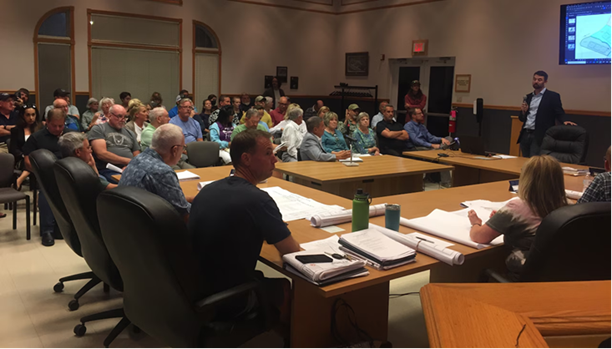
“Happy people don’t attend night meetings,” my internal voice whispered as I pulled into the overflowing municipal parking lot. Judging by the line at the sign in table, it was going to be a long evening. Inside, the familiar scene unfolded: residents in coordinated shirts gathered in the back, comparing notes, while the development team, polished and prepared, occupied the front row. A quiet tension settled over the room as the township supervisors took their seats. Within a few hours, the fate of data centers in the township would be decided.
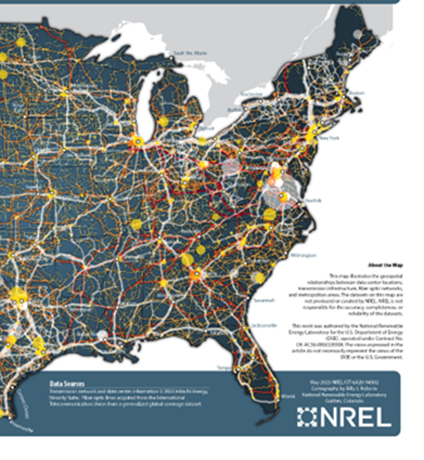
Data centers have become one of the most pressing issues in municipal land use planning across Pennsylvania. A newly released map from the National Renewable Energy Laboratory shows why. A quick glance at the map shows corridors of transmission lines and fiber optic lines reaching north to Pennsylvania from Ashburn, Virginia, the recognized data center capital of the world that is often referred to as the “center of the internet.” When coupled with proximity to high demand markets, available land, and abundant water, data centers quickly spring up along these infrastructure tentacles in Pennsylvania.
With this infrastructure in place, data center project proposals and zoning amendments are the main event at municipal meetings across the Commonwealth. Whether you are in rural Salem Township in Luzerne County, the urbanized City of Lancaster, or the rapidly growing suburbs of Cumberland County, data centers are on the forefront of community interest and concern. The issues of the expanding digital economy, data security, tax revenue, energy usage, water supply, and job creation are hotly debated as this new land use creeps into the Commonwealth’s landscape.
Cumberland County is home to one of the largest data center projects in the state. Nicknamed “Project Bolt,” the 700-acre project site is in Middlesex Township, Cumberland County. The project will include 3 campuses with 18 total buildings comprising 4.2 million square feet of floor space. The site provides access to 17 metropolitan fiber optic networks and is anticipated to be fully operational by 2030.
Even before Project Bolt was announced, the Cumberland County Planning Commission (CCPC) had begun preparing for the data center boom. At its 2023 board retreat, the CCPC identified data centers as an emerging land use trend requiring research and guidance. Staff developed a white paper outlining data center basics and regulatory considerations for the county’s 33 municipalities. Requests for technical assistance quickly followed as local governments sought to update their ordinances.
The experience in Cumberland County offers data center best practices that are widely applicable to local governments across the state. Through research, project review, industry collaboration, and municipal assistance, several key lessons have emerged.
1) Define the use
Land use case law requires that municipalities that choose to zone, must accommodate all lawful land uses. Municipalities cannot simply prohibit data centers or hope that development proposals bypass their community. A data center is an emerging use, one projected to only grow in the future…they are not going away. Proactive planning will enable municipalities to benefit from data centers while avoiding negative impacts.
So, what does proactive planning look like? First, zoning ordinances should include a solid , industry accepted definition of data centers. Data centers vary in size and scale, from small modular units to large hyperscale facilities consuming 1000 acres or more. Properly defining the use enables a municipality to compatibly match the type of data center to the most appropriate commercial or industrial zoning district.
Additionally, data centers commonly include accessory uses such as energy generation, backup power storage, or water storage towers. Understanding and including those accessory uses in the definition allows reasonable, expected data center development while avoiding time consuming, costly trips to the zoning hearing board for trivial relief from narrowly defined zoning standards.
2) Locate the use where it belongs
Proactive planning permits data centers in the most appropriate locations and discourages their development in locations where natural resource or land use compatibility concerns may arise. Data centers function best where electric transmission, fiber optic networks, and water resources converge. Coordination with public utilities, public water suppliers, and telecommunications providers will help municipalities further match siting requirements with available land.
At the same time, siting must respect natural resources and community character. Facilities should avoid critical aquifer recharge zones, prime farmland, sensitive habitats, and areas where noise or lighting could affect residential neighborhoods. These community factors should be prioritized for all land uses in a community, not just data centers.
3) Zone consistently
Despite their energy and water demands, data centers are fundamentally industrial buildings housing computer servers. Municipal zoning ordinances often miss this fact and impose disproportionate restrictions that can unintentionally (or intentionally) preclude the use and expose municipalities to legal challenges.
For example, new data center regulations may require extensive building setbacks of 100 feet or more while other industrial uses such as distribution centers or manufacturing operations carry lesser standards. Decommissioning requirements may require data center developers to post financial security to dismantle a vacated project while surrounding overgrown office buildings and blighted shopping malls carry no such requirement. Meticulous façade requirements applied exclusively to data centers ignore the unimproved aesthetics of the industrial warehouse located directly across the street.
Municipalities should treat data centers similarly to other commercial and industrial uses, while allowing room for heightened regulation of characteristics unique to data centers.
4) Recognize developers as partners, not adversaries
Too often, data center developers are unfairly portrayed as unethical opportunists seeking to exploit a community’s environment and quality of life for personal gain, only to disappear once profits are secured. Developers share the same concerns about natural resources and quality of life as residents; without these, they cannot attract clients or sustain operations. Their projects often bring significant benefits, including improved infrastructure, increased tax revenue, and the creation of local jobs.
Early engagement is invaluable. Prior to project proposals, municipalities should meet with industry representatives to learn about trends, understand best practices, determine likely locations for projects, review proposed zoning regulations, and discuss critical infrastructure.
Site visits to existing data center projects, especially those in nearby Ashburn, VA, offer firsthand insight into noise levels, aesthetics, and surrounding land uses. Stand near or walk by an actual data center. How loud is it? Does it look nice? What other uses are located nearby? How does it compare with other commercial or industrial buildings in the area?
Often data centers developers are willing to enter into community benefit agreements, or CBAs, where they voluntarily agree to fund important projects in a community. Fire apparatus, parks, workforce development, and infrastructure development projects are commonly found in CBAs. Creating a positive relationship with data center developers facilitates such agreements with long term benefits for the developer and the community.
5) Collaborate on what you cannot control
Energy pricing and water allocation are major public concerns, yet municipalities have limited authority over either. Electricity generation, transmission, and pricing are governed at the regional grid level, while large water withdrawals fall under the jurisdiction of water authorities, public water providers, and regulatory agencies.
Municipalities can, however, collaborate with these entities. Seeking and sharing information from PJM, the grid manager for the northeast, and public utilities may help municipalities, and their residents understand the preventive measures taken elsewhere to protect against data center induced price increases. Similarly, meetings with the municipal water authority, river basin commission, or public water supplier can help to coordinate municipal land use policies to ensure that enough water is available to support a preferred future land use plan and not just data centers.
By seeking and sharing this information with residents, municipalities can close an information gap that fuels resident frustration when they do not understand all aspects of a data center project.
6) Prioritize transparency
Pennsylvania’s nearly 2,600 municipalities reflect a strong preference for local decision making. Municipal elected officials have the daunting challenge of ensuring that all voices are heard and lawful decisions reflect the will of the people.
Transparency begins with the basics of public meeting execution. Broad advertising, timely information distribution in multiple formats, and accessible room setups, adequately sized for everyone to see and hear lay the foundation for genuine participation. Skilled chairpersons who clearly outline input procedures help maintain order and ensure everyone can speak. When any of these critical best practices is missed, meetings quickly spiral out of control, sowing the seeds of distrust and frustration while complicating the decision-making process.
Data center projects often draw regional interest, raising questions about who should be allowed to speak. While elected officials represent their own constituency, impacts such as noise, stormwater, groundwater, and school taxes cross municipal boundaries. Nonresidents can be impacted by data center projects just like residents of the host municipality. Establishing clear standards for regional input ensures that all affected parties have a voice.
7) Preparing to succeed
As Pennsylvania communities navigate our nation’s increasingly digital future, the rise of data centers is not a remote possibility but rather an active force shaping local economies, landscapes, and infrastructure. Benjamin Franklin’s timeless warning that “by failing to prepare, you are preparing to fail” should resonate with Pennsylvania’s municipal leaders. Municipalities that proactively plan for data center development through thoughtful zoning, collaborative partnerships, and transparent community engagement, position themselves to enjoy reliable digital access, job creation, and increased tax revenue. Those that do not risk being caught off guard, facing irreversible strains on natural resources, degradation of quality of life, and missed economic development opportunities. Is your municipality prepared?
Article from the February 2026 Municipal Reporter | Pennsylvania Data Centers Edition