BY Andrew Dehoff, P.E, SRBC Executive director, Kristen Bowman Kavanagh, P.E. DRBC Executive Director and Mike Nardolilli, ICPRB Executive Director
For the Commonwealth’s regional water resource managers, the catchphrase of 2025 was “data centers.” While conversations from kitchen tables to Harrisburg have centered on large data centers’ robust power needs and 24/7 operating requirements, increasingly recognized is their need for sustainable water access, as water is critical to both the power and the cooling required to operate these large facilities.
As such, water is expected to be ever more in demand, and regional water resource managers in the Susquehanna, Delaware and Potomac river basins are focused on understanding this emerging industry to ensure its growth is responsibly managed among other shared water needs.
A new thirst for water
It has been estimated that a single, large data center facility can use up to 5 million gallons of water per day, and much of this water is used consumptively, meaning it is not returned to its system of origin. Importantly, the daily 5 million gallons does not include water required to generate the power needed to operate a data center, making its water demand even more intense. Another way to look at a data center’s water usage: According to University of California researchers, each AI-prompted email of 100 words uses the equivalent of a 16 oz. water bottle. Considering how many people now use these tools daily, the thirst for water can seem unquenchable.
The Commonwealth of Pennsylvania has roughly 86,000 miles of rivers and streams. While that sounds like a lot of water, supporting all water resource needs in the future may be challenging. During droughts or other water shortages, water resource managers will need to consider how to prioritize water for data centers among the needs of domestic, commercial, industrial and agricultural uses, and water systems that sell water to data centers will need to consider whether their supplies will be capable of continuing uninterrupted.
Pennsylvania’s River Basin Commissions
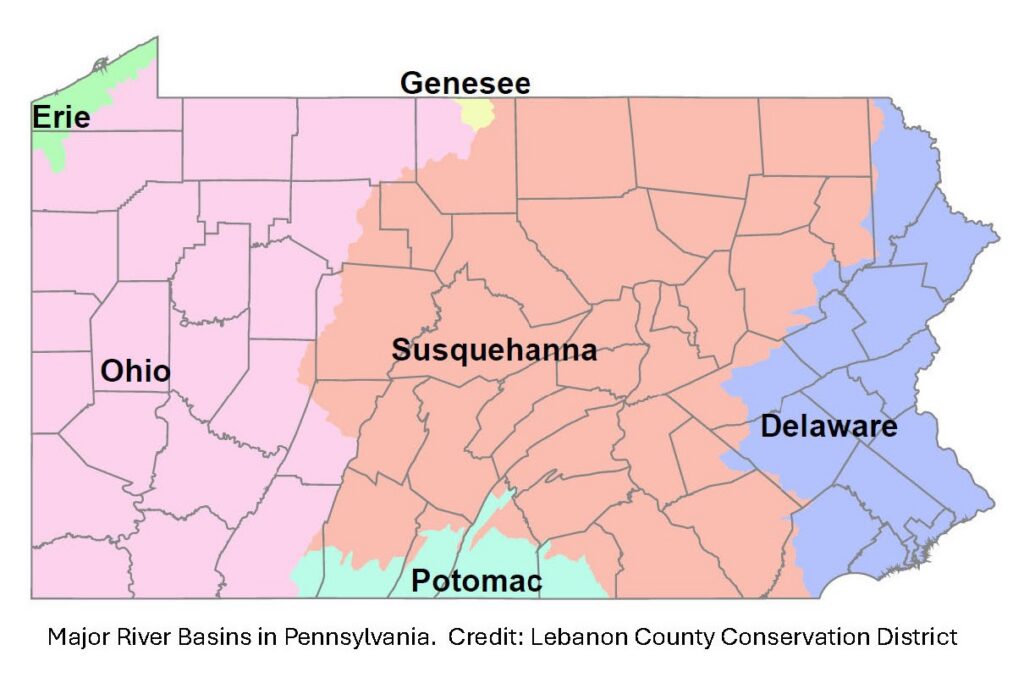
The Susquehanna River Basin Commission (SRBC), the Delaware River Basin Commission (DRBC), and the Interstate Commission on the Potomac River Basin (ICPRB) are government agencies working in their respective watersheds to manage water resources without regard to political boundaries.
While their authorities are slightly different, each are compact-founded agencies focused on sustainably managing water supply through regulation, monitoring and/or comprehensive planning programs. Each commission balances competing water needs to ensure long-term health and viability of its basin’s water resources for residents, businesses and ecosystems. The work of these commissions is critical because their watersheds supply drinking water to more than 23.6 million people in seven states and the District of Columbia, including roughly 72% of the Commonwealth’s total population.
The SRBC regulates certain water withdrawals and consumptive uses within its jurisdiction. Currently, the SRBC has issued a permit for one data center project in Luzerne County. However, more applications for data center projects are expected. In 2025, the SRBC expanded on an existing resolution to encourage data centers and other emerging facilities to consider the use of dry, hybrid or other water-saving technologies for cooling purposes. These technologies use ambient air to cool and condense steam, drastically reducing water consumption, and are currently employed by some power plants.
The DRBC regulates water withdrawals and discharges over certain thresholds. To date, the DRBC has not received any applications for large data center projects. There is an existing footprint of roughly 60 small- to medium-scale data centers currently operating in the basin, obtaining water from existing public water supply sources. Because these do not operate their own water systems, they did not need DRBC approval. DRBC staff are aware of several proposed hyperscale facilities. If these facilities require their own water systems to operate and exceed the Commission’s thresholds for review, they will need to apply to the Commission for approval.
The ICPRB was formed to address water quality challenges in the Potomac and in the 1970s was also tasked with regional water resource and land use planning. Unlike the other commissions, the ICPRB does not issue regulations or permits. The Virginia portion of the Potomac River Basin has already seen a large increase in data center development. This “head start” has allowed ICPRB to conduct research on data centers’ water use. The Commission evaluated implications for the reliability of regional water supply and long-term planning, and its findings provide insights that are helping decision-makers and stakeholders navigate the intersection of water, energy, technology, and infrastructure in support of regional resilience.
Future-focused, together
Looking ahead, the agencies will continue to work cooperatively with one another and with our partners to track proposed data centers and evaluate policies to reduce water impacts. The commissions also continue to coordinate with Pennsylvania Department of Environmental Protection on proposed projects and emerging policies. And, if a data center requires either SRBC or DRBC’s approval, the relevant project review team will work to ensure the application meets all regulatory requirements.
The commissions continue to seek data centers’ water use information wherever possible, to responsibly estimate and manage water demands. Collecting this data can be challenging, as water use information of data centers tied into public water supply is not always readily disclosed. Increased transparency will be key as regulators, businesses and communities wrap their arms around this growing industry. As more data centers are planned, especially large-scale data centers, ensuring the availability of information on water sources and projected water demands will be critical.
Considering water use, stormwater management and other water resource needs in the planning stages will identify gaps and potential issues early, helping ensure all local water resource needs are balanced and supported.
The commissions are talking with utilities, other agencies and potential permittees to ensure reliable access to water while managing and protecting the long-term health of surrounding watersheds and communities. The commissions can also be a resource for local governments, so please reach out with questions or guidance on our regulatory requirements. Organizations like the Pennsylvania Municipal League continue to be an excellent source of expertise and connection for our commissions to dialogue with local governments.
The commissions have a track record of responsibly managing water supplies for millions of Pennsylvanians, and that work will continue into the future, together.
More resources on River Basin
Commissions and Data Centers:
SRBC: https://www.srbc.gov/about/news/docs/srbc-data-centers-faq.pdf
DRBC: https://www.nj.gov/drbc/programs/supply/datacenters.html
ICPRB: https://www.youtube.com/watch?v=6CJd4F_ezV0
Article from the February 2026 Municipal Reporter | Pennsylvania Data Centers Edition