Baltimore cut its homicide rate by 60% from 2021 to 2025—largely through a public health approach to gun violence.
A Contagious Peace: Behind Baltimore’s Historic Homicide Reduction
BY Melody Schreiber, article originally appeared in the Spring/Summer 2026 issue of Hopkins Bloomberg Public Health magazine and is reprinted with permission • Photos by Mollye Miller and Chris Hartlove
In eighth grade, Da’Wan started hanging out in the streets—shorthand for staying out late, dealing drugs, and generally getting in trouble. He felt like he was part of something: a family, a brotherhood. Take Ty, at age 19 a revered elder. Mornings, Da’Wan would hop in Ty’s car and they would drive around, but then Da’Wan would look up and realize Ty had taken him to school. Ty was like that—trying to steer the younger boy toward the right path. But when that didn’t stick, he taught him everything he knew about navigating the streets.
Once, in 2024, Da’Wan tried to get out of the life, going to live with his dad in Newark, Delaware. It only lasted two weeks. “I love Baltimore. I couldn’t do it,” Da’Wan says. “I had to go home.” He took an Uber back to his mother’s house—a $128 ride, but worth it to be back to the only place he’d ever felt he belonged. It was sheer chance—or, as Da’Wan now likes to think, God’s will—that he stayed home one day last April when the gunshots rang out. But Ty was outside. He died of his wounds.
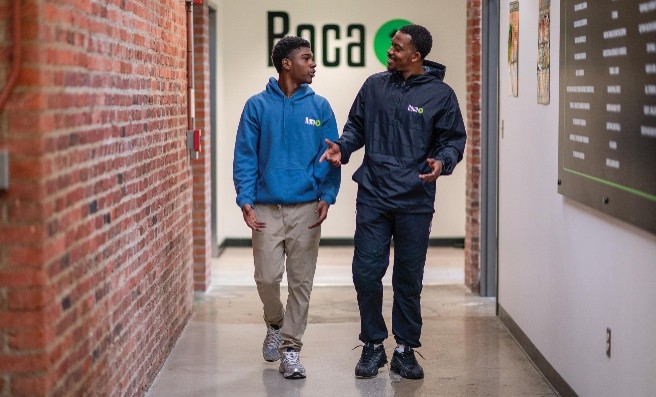
Ty’s death tore at Da’Wan. Perhaps the worst part was seeing Ty’s mother grieving. “I seen what his mother was going through, and every time I looked at his mother, I seen my mother,” he says. He didn’t want to cause his mom to suffer. And, at 16, he was tired. He didn’t want to spend his whole life looking over his shoulder.
When Ty died, someone from Roca knocked on Da’Wan’s door. Roca is a gun violence prevention program that began in Massachusetts and expanded to Baltimore in 2018. The Roca worker asked what Da’Wan needed to get his life back in order. A safe place to live, food, help getting a job? Now, at 17, Da’Wan has a girlfriend and a steady job at Burger King. He’s planning to graduate high school in August. One day, he hopes to be a mentor with Roca, to “help people and to tell them not to do what I did.”
Gun violence becomes the priority
In 2025, Baltimore homicides plummeted to 133—a nearly 60% decline since 2021, and the lowest rate per 100,000 people in a half century. Homicides are falling in many cities nationally, but Baltimore’s pattern is different. It preceded the national decline, and it fell further and faster than in any other American city. The reasons are complex. For instance, the recovery of “ghost guns,” which carried no serial numbers and can be assembled at home, dropped dramatically after federal and state rules requiring their sale be treated like any other gun. But one major reason for the change, advocates believe, is because of slow and steady changes led by Mayor Brandon Scott, the community, and organizations like Roca. They treat gun violence as a public health issue that can be greatly reduced by stable housing, quality employment, access to transportation, and other opportunities for kids like Da’Wan, who was connected to Roca via Baltimore’s group violence reduction strategy (GVRS). Roca helped him get his state ID card so he could get a job, and now they’re working on his driver’s license. One night, when he had a fight with his mom, they put him up at a hotel. Without that safety net, his only option would have been going back outside.
“Gun violence often acts analogous to a contagious process. We think of it as a social contagion,” says Daniel Webster, a distinguished scholar at the Bloomberg School’s Center for Gun Violence Solutions. Just as measles or sexually transmitted infections spread through social networks, so does gun violence. And shootings don’t just affect shooters and victims—they ricochet through communities. Arrest and incarceration, too, can metastasize. Funneling people into the criminal justice system cuts off their options. Many of the people at risk of gun violence also live in neighborhoods that have long been neglected.
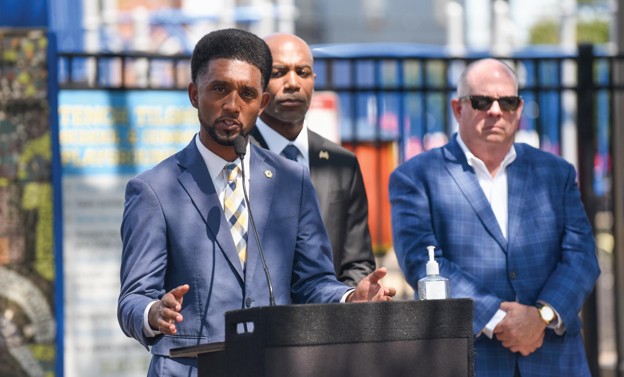
Mayor Scott, elected in 2020, made reducing gun violence his No. 1 priority. It’s the reason he became a public servant, he says. “As a young, poor Black man who experienced gun violence and all the impacts of gun violence at a very young age, it is the top priority for me and always will be,” he says. Even as a City Council member more than a decade ago, he spoke about gun violence as a public health issue. Before that, he worked in the Mayor’s Office on a previous attempt at curbing gun violence. Growing up in Park Heights, he saw every failed effort firsthand. “All they did was really make life hectic for folks like me, right? Because I wasn’t ever involved in those things, but there were seven times in my life where I was put in handcuffs simply because I was breathing and Black outside.” Those harsh policies never made a dent on homicide rates, he says: “The bodies did not stop dropping.”
Baltimore’s first comprehensive violence prevention plan takes public safety beyond police, prosecution, and prison by working closely with community groups to focus on prevention and support for those most affected by the violence.
The community organizations, some partially funded by the Mayor’s Office, connect people to education and life coaching. They help get documents like IDs, birth certificates, and Social Security cards, and they help expunge criminal records, making it easier to get jobs. They pay energy bills and fill gas tanks; they offer emergency relocation, financial stipends, transitional employment support, drug treatment—even helping people to reconnect with their families.
Community members say the programs have begun shifting their experience of life in the city. “Our entire Baltimore public is seeing themselves as an active part of making Baltimore an increasingly peaceful city,” says Stefanie Mavronis, director of the Mayor’s Office of Neighborhood Safety and Engagement (MONSE). “The same way that violence is a contagion, peace is also contagious.”
Small number of offenders, outsized effects
There are different forms of gun violence: domestic violence, mass shootings, suicide, and more. But in Baltimore, as in many cities, group-related violence predominates, responsible for 50%–70% of all gun violence. It’s different from gang violence, which only contributes to 11% of homicides nationwide, Scott points out. It’s usually interpersonal conflict— “just simple, basic human conflict.” And when they dug into the data, they realized that most people who were being arrested for gun charges weren’t actually the worst offenders. “It’s a very small number of people committing the majority of our violence,” Mavronis says.
Focused deterrence strategies like GVRS that partners with law enforcement, neighborhood representatives, city officials, and community organizations like Roca, have been around, in various forms for more than 30 years. The program under Mayor Scott began in 2022 as a pilot in one police district. Now it’s in five, with plans to encompass all nine districts within the next year or so. They don’t just identify the victims of gun violence; they look at family and friends who might also be driven to retaliate, putting them at the highest risk of being involved in the next shooting.
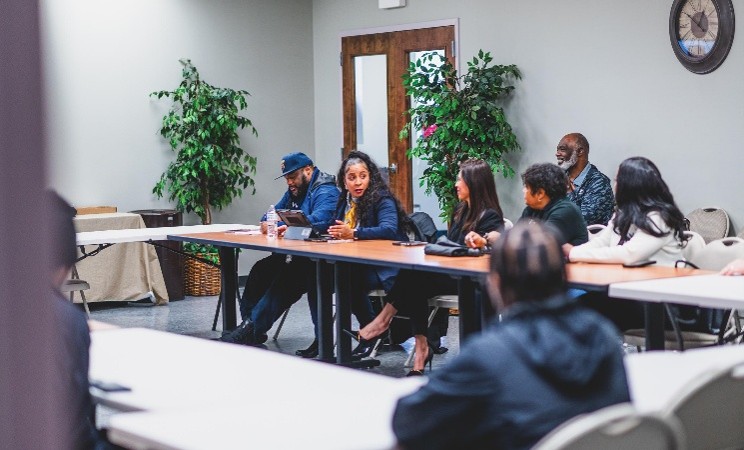
Every Thursday, a group gathers in a church in the heart of Baltimore. Police officers and representatives from the Mayor’s Office and community groups together review each group-related shooting in a slide show, put together by the Mayor’s Office, of individuals with any connections to the shootings. Some weeks, there are none; sometimes, there are 10 or 15. At a recent meeting, when a photo flashed on the screen, one woman from a community group stirred: “I knew him years ago, used to do his hair. His grandma lives next door to me, and his father lives around the corner,” she says. This often happens—a community representative knows someone who might help get the message across.
In the days and weeks after each meeting, all three groups—the Mayor’s Office, the police, and the community representatives—coordinate times to knock on doors, call cell phones, walk the block, and try to reach the individuals they’ve identified with a two-pronged message.
First, the stick: The individual is on the police’s radar now, and they will suffer the consequences if they commit any violence, the law enforcement officers warn. Crucially, the next part is the carrot: “We’re going to promise to try to help you change in a different direction, in a safer direction,” Webster says. Many of the people they identify are caring for others in their lives: grandparents, parents, children. “You can’t continue to put yourself at risk,” Mavronis says. “You have to be there to provide for them. What can we do to make sure that you are set up for success and that you’re able to stay in that place and on the right path?”
This is more than just police clearing a corner, making as many arrests as possible. “I’ve actually studied that, and it doesn’t work particularly well in curbing violence,” Webster says. “That was a very inefficient, unfair, and frankly ineffective way to try to curb violence.” Sometimes, it actually can spur more violence, and it means a lot of people end up with criminal records, which makes it harder to find safer paths.
Instead, a public health approach means digging into the data, focusing on those at highest risk, constantly evaluating what is working and what isn’t. This program is a form of harm reduction, Webster says: “As long as they are not doing the most harmful thing, which is shooting people, we’re not going to bother them. And that is the shift, and truly a reform in policing and the criminal justice system.”
The mayor making the initiative a top priority has helped its success—but Scott also points to the importance of providing enough resources and making prevention comprehensive by focusing on gun trafficking, manufacturers and distributors, hospital-based prevention teams, investments in the workforce, and the expansion of community groups. “It’s all of it together, but GVRS is the flagship because it is us doing what we should have always been doing—and that’s focusing in on the people who are the most likely to be the victim or perpetrator of gun violence and building cases on those who refuse to put down the guns and giving the other people the opportunity to change their life,” Scott says. “People are resolving their conflicts in a different way, because now the city’s culture is ‘No, we can do something different. We can be better.’”
Community showing care
The key part of this work is the partnership with community service providers. The biggest partners are Roca and YAP, which do intensive outreach and case management with an evidence base of success, Biddle said. But other organizations and individuals are also an integral part. One of the community organizations is the PEACE Team. Eric “EB” Brown founded it six years ago, while serving a 27-year sentence for drug charges, as a way to mediate conflicts behind bars. He has since recruited mentors in other facilities across Maryland as well. When the mentors got out, they brought PEACE with them. There are now between 30 and 45 mentors working in Baltimore and other parts of Maryland, doing anything the community might need: wellness checks, snow removal, helping elders carry groceries, and cooling conflicts. They also show up at school dismissals to help solve problems that arose during the day and make sure kids get home safely. They’ll show up in the morning, too, because some kids hang out in front of the schools, smoking weed, gambling, and shooting dice.
“We’ve been on the path that you’re on,” says Brother Angola, PEACE Team’s chief administrative director. “We know how your story is going to end way before you even get to that point. So let’s try to change this, and we’ll help you change it. We’ll provide you with the resources that you may need to change this outcome.” Support from the Mayor’s Office has been “a game changer” for the PEACE Team. “We’re locked into Mayor Scott’s vision,” Angola says. Brown adds: “What we try to do is change the culture. Bringing life back into the community. And we see that it makes a difference.”
The gift of gab
Safe Streets is the Baltimore version of Cure Violence, which was developed by an infectious disease epidemiologist in Chicago; it’s now rolled out to 10 neighborhoods in Baltimore. Safe Streets is managed by the Mayor’s Office and the nonprofits Catholic Charities of Baltimore and LifeBridge Center for Hope. Violence interrupters are usually from the neighborhoods they work in, and they often still live there.
“We’ve been studying the program since its inception, so we have a lot of data points for some neighborhoods that go back to 2007 and 2008,” Webster says. “Not every site has success, and there are certain sites that might have periods of success and then rebound into not-good outcomes.” While interrupters are very good at mediation, they still need more resources to offer the community, like what GVRS programs offer, including emergency rental assistance and help signing up for eligible benefits, Webster says. “None of that is guaranteed with Safe Streets.”
Yet the benefits of the program are immense. Every dollar invested in Safe Streets yields an estimated $7.20 to $19.20 in economic benefits. Nearly everyone on the street is out there because they don’t see any other way, Long says. “Nobody woke up and said, ‘I want to be the best murderer or the best robber, the best dope dealer,’” he says. They’re just trying to survive—and when they have other options, “they always choose the right thing.” Violence often happens when someone feels like his back is against the wall, Long says. “We really try to find ways to eliminate people feeling like this is their only option.” Someone might have an argument with their child’s mother and then head down the block to try to cool off, but the wrong joke or comment can set off “a little Armageddon,” Long says.
It’s dangerous work; some interrupters have died. Safe Streets interrupters aren’t armed, of course, and they don’t wear bulletproof vests. “The guys and ladies at Safe Streets, they’re excellent at their wordplay,” Long says. “That’s the only weapon we have. So when we go into situations, we only got the gift of gab.” The mission is also personal for many, if not all, interrupters. In 2017, Long’s sister lost her life to gun violence over a “senseless beef,” he says. They know there are dangers to inserting themselves into situations at the worst moments in other people’s lives, but they still do it.
These role models are particularly powerful because they were long admired already. “They are the same influencers who once had all the neighborhood kids wanting to sell drugs and get the best cars and all the money,” says De’Ashia Gibbs, violence prevention coordinator at McElderry Park. “That’s not the way anymore—what’s cool is to be a good dad, and stay in school, and take care of your grandma and your mother, and to be a good man. … Someone can be the biggest, baddest gangster alive, but when you know your family and your community doesn’t feel safe with you around, that causes a shift in your mindset. What’s more important to me, being a tough guy or being able to be welcomed in my grandmother’s house?”
The decline to 133 deaths in 2025 feels like a dream, Gibbs says—and it’s a reminder of what’s possible. “If we could get that low, then we could get lower,” she says. “If we continue to have the leadership that supports this type of work, then I can’t imagine how much better it can get.”
Article from the August 2026 Municipal Reporter | Public Health