BY Susan Schrack Wood, Ph.D., Director of Communications, PA Municipal League
Mary Smith* lives in Dauphin County, her aging parents live in rural Huntingdon County. Like many in the Baby Boomer and Silent Generations, her parents want to remain living independently in their home rather than move into one of the county’s four nursing home facilities. According to the Center for Rural Pennsylvania, Huntingdon County has one hospital and three rural health clinics to serve its more than 44,000 residents, at least 21% of them over the age of 65. Mary says for routine healthcare, her parents had to travel 30 minutes over mountainous terrain to the next county to see a personal care physician; a taxing endeavor, particularly in winter. The local hospital handles emergencies, but Mary felt the quality of care was lacking with misdiagnoses and incorrect medication prescriptions which only exacerbated her parents’ health conditions.
Specialists are scarce in Huntingdon County. Mary would regularly travel two hours each way to her parents’ home to help with medical appointments, which often required driving to State College or Altoona. When Mary’s father needed a urologist, and her mother needed memory care she brought them to Penn State Health locations in Lancaster and Hershey. She is now working to get them into assisted living and nursing care facilities in Dauphin County.
Mary’s story is a familiar one for those living in rural counties in Pennsylvania. 48 of the Commonwealth’s 67 counties are classified as rural where the nearest emergency room, obstetrician, or psychiatrist can be a 40-minute drive away, if it exists at all. For the roughly 3.4 million Pennsylvanians who live in these rural counties, health care isn’t given. It’s a system under visible strain, particularly for the aging and other vulnerable populations.
Rural Pennsylvania carries a disproportionate share of the state’s chronic disease burden. According to Pennsylvania’s Rural Health Transformation Plan (Pennsylvania Department of Human Services, February 2026), rural residents have higher rates of coronary heart disease, obesity, and diabetes than their urban counterparts, and while overdose rates are somewhat lower in rural counties, suicide deaths tell a different story, running higher than in urban areas. These statistics translate into shorter life expectancy, more preventable hospitalizations, and greater strain on a thinning network of providers.
Rural Potter County is in the process of decommissioning its county agency for aging, which protects older adults from abuse and neglect. This is an unprecedented event for the state, although it was the county that made the request. PA Secretary of Aging, Jason Kavulich, introduced a new monitoring system last year for evaluating counties’ agencies and responses to aging populations needs. 30 local agencies have been assessed so far, and of those, 16 have fallen below the 75% threshold in the risk and mitigation category, according to department data. Despite the increase over the past decade in the number of older Pennsylvanians who die while their abuse and neglect cases are being investigated, Kavulich said (in that interview) he does not believe there is a crisis.
The problems extend beyond the ageing population to healthcare for the overall population. More than two dozen hospitals have closed in Pennsylvania since 2016, and the trend has only accelerated: a study commissioned by the Hospital and Health system Association of Pennsylvania warns another dozen or more facilities could close in the coming years without state intervention. Some communities are already living the consequences: one small hospital in a northern county closed this year, leaving a rural county of 35,000 residents with just 14 inpatient beds.
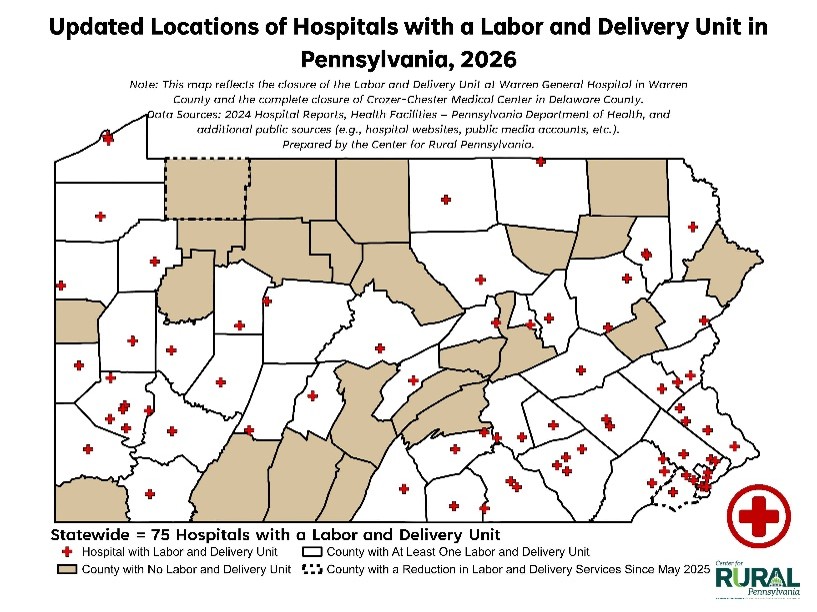
Maternal health access has become an especially acute concern. County-level mapping shows large swaths of rural Pennsylvania are now more than a 20-minute drive from a hospital labor-and-delivery unit, and the state currently has only 75 hospitals with labor and delivery units to serve the entire Commonwealth, a number that keeps shrinking as rural obstetric units close for lack of volume and staffing.
Why Rural Hospitals Keep Closing
Understanding the “why” matters for local leaders trying to intervene early. As reporting in The Conversation (April 2026) explains, rural hospitals operate under a structural bind: they carry high fixed costs for staff, equipment, and facilities that don’t shrink even when patient volume does, and they rely heavily on Medicaid and Medicare reimbursement, which typically pays less than private insurance. ⁵ A hospital in a county of 10,000 people simply cannot spread its overhead the way a suburban academic medical center can.
Federal policy has intensified the pressure. The 2025 federal tax and spending law reduced Medicaid eligibility nationally and capped federal reimbursements to hospitals. This is a direct hit to facilities that depend on Medicaid patients to stay afloat. State officials estimate Pennsylvania could lose roughly $20 billion in federal Medicaid funding over the next decade, beginning in 2028, on top of the $32.6 billion the Commonwealth currently receives annually.⁶ Pennsylvania is set to receive close to $200 million in 2026 through the federal Rural Health Transformation Program, but even with this new federal rural health investment arriving, policy experts caution the funding won’t fully offset the deeper Medicaid cuts working their way through the system.
For township and county officials, the practical translation is this: the hospital or clinic anchoring your local economy and emergency response system may be more financially fragile than it appears, and the timeline for a funding gap to become a closure announcement can be short.
Facility closures are the most visible crisis, but they sit on top of a deeper structural problem: not enough people to staff the system that remains. Rural Pennsylvania struggles to recruit and retain physicians, nurses, behavioral health clinicians, EMS personnel, and dentists. Younger clinicians often train in urban academic centers and stay there; rural practices compete against better pay, more manageable caseloads, and spousal employment opportunities in metro areas.
This shortage compounds every other rural health challenge: Behavioral health access is severely limited, even as suicide rates run higher in rural counties than in urban ones. This leaves residents without local options beyond their emergency department or turning to social media. Emergency medical services generally rely on volunteer squads that cover large geographic areas, which means longer response times for time-sensitive emergencies such as heart attacks and strokes. While telehealth is emerging as a possible solution to some primary or routine care issues, not everyone has reliable broadband.
The State’s Response
In 2025, the state released its landmark $193 million Rural Health Transformation Plan (RHTP). It is the first stand-alone rural health plan the Commonwealth has produced since 2000 (Pennsylvania Office of Rural Health, Penn State). Developed with input from rural community leaders and health professionals, it prioritizes access to care, behavioral health, oral health, maternal health, workforce development, broadband connectivity, and health equity. ⁹ Act 45 of 2025 gives the Department of Human Services clear authority to administer the RHTP, distribute funding, oversee implementation, and monitor compliance with state and federal requirements¹⁰ ; However, in order to balance the overall state budget, the state is delaying $2.6 billion in Medicaid managed care payments over two years. There is concern among those with the Hospital and Healthsystem Association of Pennsylvania that this will impact cash flow in low-income rural clinics.
The Shapiro administration hopes to reduce hospital visits by about 50% and reduce overall healthcare costs by 16% through an “Investments in Health” pilot program. Through the program, Medicaid recipients with certain diet-sensitive chronic health conditions will receive medically tailored meals that can improve their health, reduce the need for hospital stays and other costly interventions, and reduce health care spending.
A $900,000 investment of state funds will expand already existing work in this area, focusing on people with heart disease, diabetes (including gestational diabetes), end stage renal disease, and cancer patients actively receiving chemotherapy. Pennsylvania would be able to leverage additional federal matching funds, bringing total funding to $2.3 million. The pilot is modeled after successful programs in other states.
What Can Local Government Do?
Municipal managers, township supervisors, and borough councils don’t set Medicaid reimbursement rates or federal health policy, but local government has some options to improve their rural health options and outcomes.
- Treat health system stability as economic development. A rural hospital or clinic is often among a county’s largest employers. Local officials can build early-warning relationships with hospital administrators and health system leadership rather than learning about a closure from a press release. Regional economic development offices and county planning commissions can incorporate health facility viability directly into their long-range planning, the same way they track major employers in manufacturing or agriculture.
- Champion broadband as health infrastructure, not just an economic amenity. With the state’s Broadband Equity, Access, and Deployment Program directing over a billion dollars toward closing connectivity gaps, local leaders are well positioned to ensure telehealth-capable broadband reaches the households that need it most, not just commercial corridors. Municipalities that flag underserved pockets during grant application and mapping processes materially shape where that money lands.
- Support regional EMS and transportation coordination. Individual municipalities often can’t sustain a fully staffed EMS squad alone. County-level coordination with shared staffing agreements, regional dispatch, mutual aid compacts can stretch scarce paramedics and reduce response times more effectively than each small township trying do it alone. The same logic applies to non-emergency medical transportation: coordinating with area agencies on aging, community action agencies, and rural transit authorities can close real gaps for residents without reliable transportation.
- Invest in the local workforce pipeline. Counties and school districts can partner with community colleges, career and technical centers, and Area Health Education Centers to build “grow your own” pipelines with scholarships or loan-forgiveness incentives tied to local service commitments for nursing, EMS, and behavioral health students. Some of the state’s most successful rural retention strategies start with recruiting students who are already from the community.
- Weigh in during state and federal funding processes. Rural Health Transformation Program dollars, State Directed Payments, and BEAD broadband funds are all being shaped through public comment periods, planning processes, and legislative hearings happening now. Local officials who show up with data on their own county’s hospital capacity, ambulance response times, or broadband gaps can carry real weight in how state agencies prioritize funding.
- Use behavioral health and oral health as low-cost entry points. Not every fix requires a hospital. School-based behavioral health partnerships, mobile dental units, and co-located services at libraries or senior centers can extend access without the capital costs of a new clinic, and they’re often eligible for state and philanthropic grant support specifically earmarked for rural service gaps.
Federal Medicaid changes are tightening the financial vise on already-strained hospitals, even as new federal and state investment tries to offset the damage. The next few years will determine whether that investment arrives in time, and whether it’s directed toward the communities that need it most.
Local government leaders won’t decide federal reimbursement formulas. But they will decide whether their community shows up in the room when funding gets allocated, whether their broadband map accurately reflects who’s still offline, and whether their EMS system is built to survive the retirement of a single volunteer coordinator. In a rural health landscape this fragile, those local decisions are not peripheral to the crisis, they could be the difference between a community that adapts and one that loses its last clinic for good.
Article from the August 2026 Municipal Reporter | Public Health